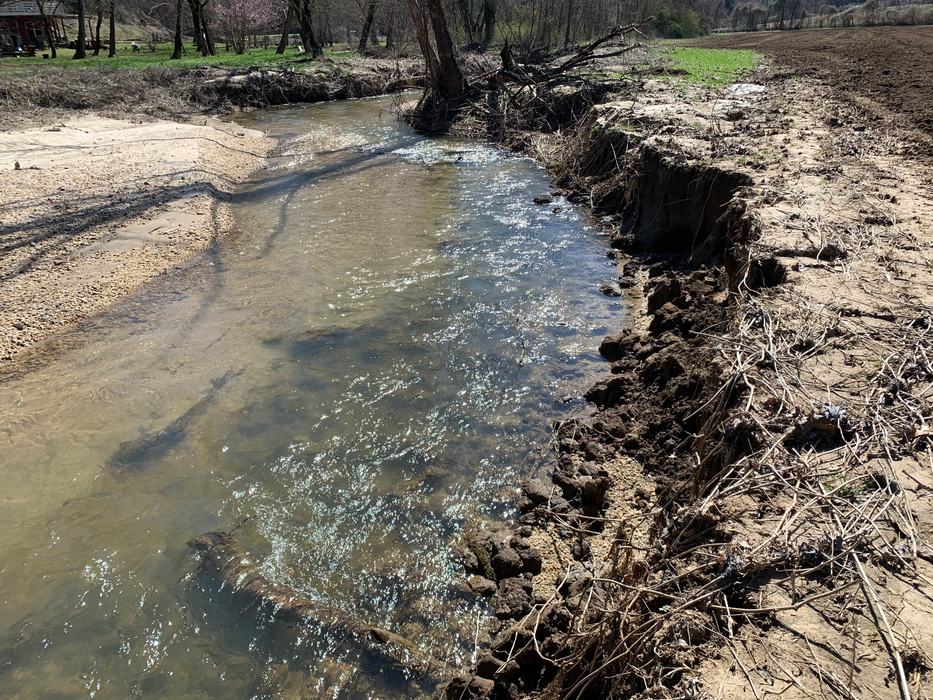
Do you have a stream that is losing soil along the banks? Are your streambanks steep? If so, then you may need to remediate the situation by stabilizing the land along your stream to save your land.
Small Scale Solutions to Eroding Streambanks
(Updated: March 4, 2026, 4:04 p.m.)

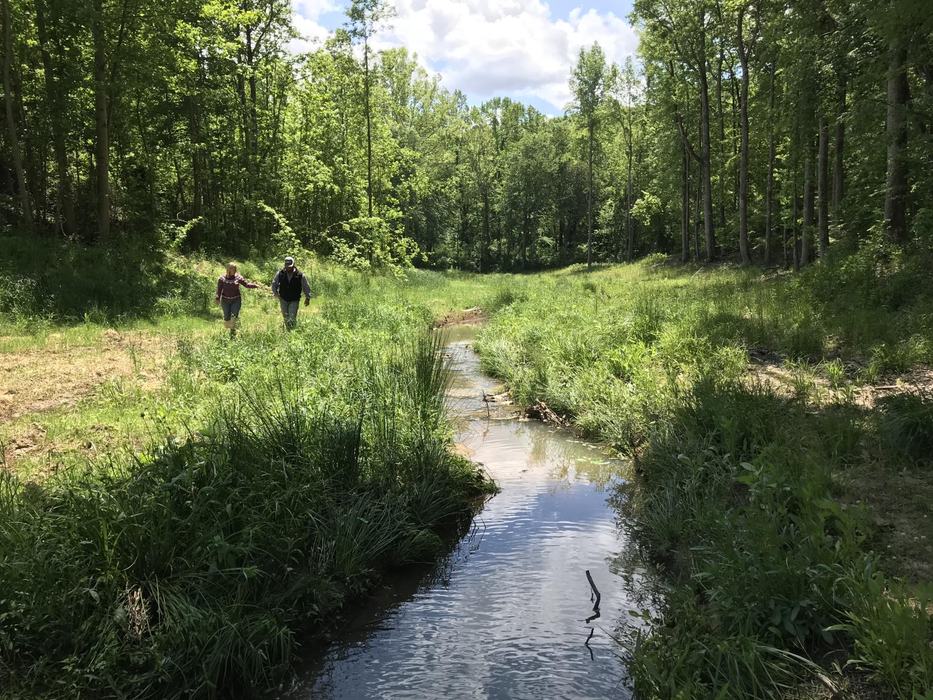
This streambank has been graded to reduce the slope. Then erosion matting is installed and live stake plants are planted. Photo courtesy of Mills River Partnership.
Remediating streambank erosion is accomplished by stabilizing the soil. Plants are the best way to hold streambanks together. Larger erosion issues may require grading the land to decrease the slope of the streambank.
Learn more about remediating eroding streambanks by checking out the NC State 'Small Scale Solutions to Eroding Streambanks' publication.
"Plants are the best way to hold streambanks together."

Plants hold streambanks together.
Live staking
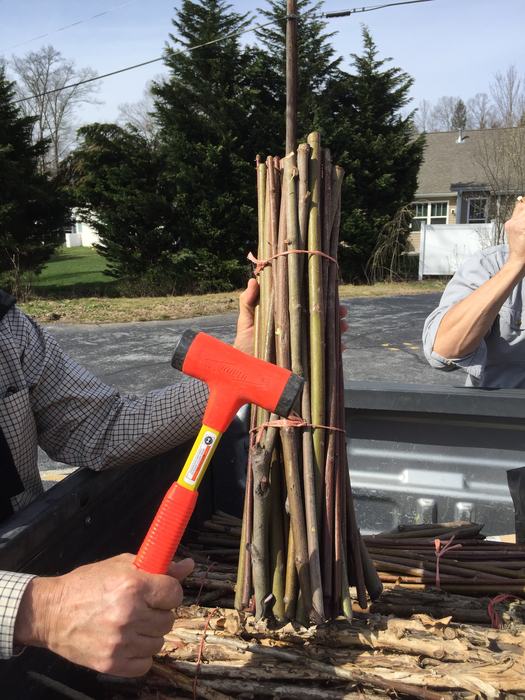
Live stakes are living branches that are harvested in the dormant season then driven into soil to establish new trees and shrubs. It is better to install live stakes during dormant season between Dec 1 - April 1. Dormant stems of certain species of plants such as itea, nine bark, willow, etc. will root when planted as live stakes in the winter.
It is recommended to use a 2 step process to stabilize streambanks during summer months:
* April - December: temporary and/or permanent streambank seeding and erosion control matting application where possible
* Dec 1 - April 1: Install live stakes following recommendation in our Live Stake Installation Guide.
Temporary and permanent seeding recommendations:
Attached below is the NC DEQ seeding guide for the mountains:
Riparian Area Seeding for WNC Mountains - Fact Sheet (PDF)
Note some important details:
- May 15 is listed as the recommended transition date from winter/fall seeding of a temporary mix of wheat, rye grain, or annual rye to the spring/summer seeding of german millet, browntop millet, or pearl millet.
- When seasons overlap (like early spring going into May) , a mixture of two or more temporary species may be necessary to obtain the best temporary coverage.
- The best practice for temporary seed mixes is to mix with and apply simultaneously at recommended rates with the recommended permanent seed mixes listed. (For best results, permanent seed mixes are not recommended until July or August.)
- Permanent seed inclusion in the mix should total 15 pounds of pure live seed (PLS) per acre drilled or 15-20 pounds PLS per acre broadcast applied.
- At least 4 species should be selected for the mixture, including one species from each type (warm and cold season and wetland).
- Selection of more than four species is recommended for increasing chances of successful vegetation establishment.
- Wildflowers can be added to the mix. They should not be counted in the minimum seeding rate for grasses.
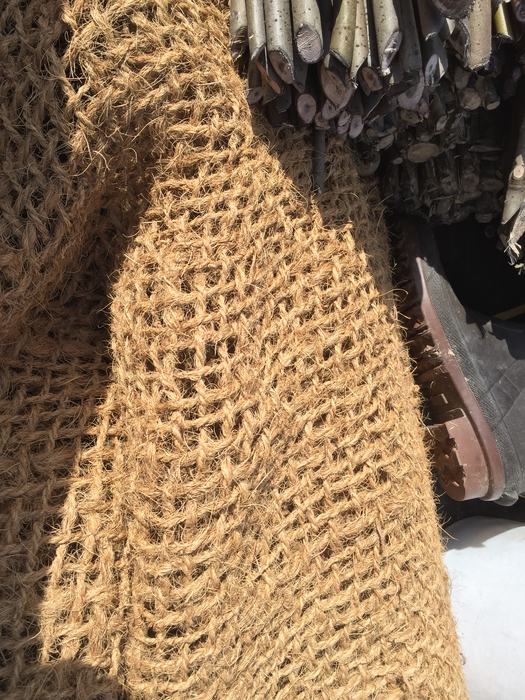
- Where / if possible, along the lower portion of stream banks subject to erosion from the stream, a rolled Erosion Control Matting Product such as a biodegradable coconut coir mat or double net coconut blanket, is recommended to install along the toe of the slope and extending up on the banks to hold seed and soil in place.
Seed Mixes:
We have used these seed mixes (Riparian Buffer Mix and/or Stabilization Mix) with good results:
Mellow Marsh Seeds offers a riparian buffer seed mix among others.
Ernst Seeds has a NC ecotype riparian selection of seed mixes.



If you do happen to have an eroding stream bank, Shade Your Stream is a cost share program that helps landowners pay for native plants to install along their streambanks.
The Mountain Valleys Resource Conservation and Development Council (Mountain Valleys RC&D) is currently accepting applications. Sign up to request assistance with this intake form.
Additional Resources:
Join our mailing list!
Enter your email address to receive updates.
Written By