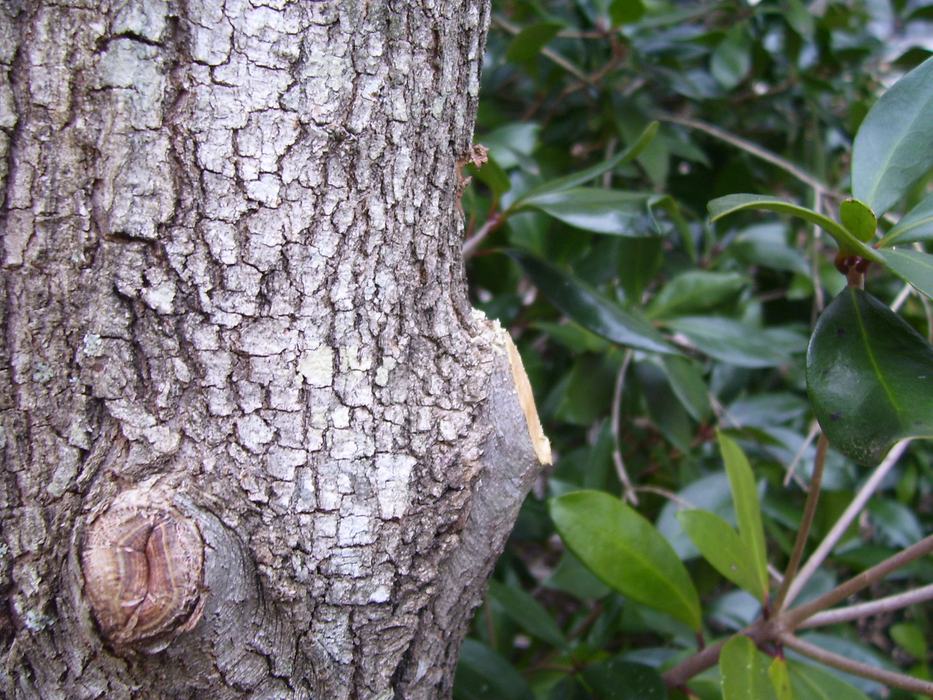
Where a limb joins the tree trunk is called the 'branch bark ridge'. This area contains the wood that will grow over the wound. Prune outside the branch bark ridge so the tree trunk can quickly seal the pruning cut. In this image you can see a year old pruning wound that is completely sealed over.
Tree vs Shrub Trees and shrubs can be divided into two groups; plants that utilize a central leader (a single trunk with a bud at the end that has superiority over all other limbs in the tree as the dominant branch) and plants that have many trunks (no single branch is dominant). Pruning these two types of plants requires different approaches.
To grow a really strong shade tree it is important to train a single leader and to submit competing leaders. An ideal young shade tree specimen should have a single straight trunk from the roots to the very uppermost bud. When the tree is too tall to prune then it is allowed to form the rounded multi stemmed canopy we are familiar with in mature shade trees.
Single Leader Trees Trees grow at the branch tips where the apical bud, the leader as it were, suppresses other buds behind it. The apical bud produces auxin, a plant growth regulator. This chemical allows the bud to maintain its position as leader by reducing the growth of its competitors. Remove this apical bud and the chemical is gone and all of the other buds are released beginning a mad dash try to assume the leader’s former role. This results in bushy growth with one or more branches that are equals. These equal branches compete for resources and space. Eventually they can create weak spots in the trunk leading to the tree splitting.
The point is to aid a single leader to maintain its position in the canopy of the tree. Tree owners can do this by pruning out any competing leaders up to a certain height. This type of pruning may be done throughout the summer. Use a pole saw (watch out for power lines!) and prune the other branches at least six inches behind the desired leader. A stub of one of the removed branches can be left and the single leader may straightened and taped to this stub with masking tape. The masking tape will last long enough to correct the leader’s growth but will rot soon enough to prevent future damage.
Some trees need more attention than others. Maples are notorious for wanting to form big round canopies at three feet from the ground. Oaks tend to want to form single leaders. Keep a close eye on your young shade trees to maintain single leaders. If you are unsure of how to do this type of pruning consider hiring a professional arborist.
Dead wood should be periodically pruned out of the crown of all trees in a process known a ‘crown cleaning’. Sometimes trees become too dense and need to be thinned in a process known as ‘crown thinning’. If a tree hasn’t been properly cared for or if something has made the crown of a tree lopsided we might shape it in a process known as ‘crown balancing’. Excessive weight on one side of a tree can actually pull a tree down over time.
The optimal time to prune shade trees is during the dormant season when all of the leaves are off the tree. It is much easier to see what limbs should be removed when there are no leaves on the tree. Pines and other conifers should be pruned in the winter to avoid attracting pests such as pine beetles.
Shrubs or multistemmed plants also need light pruning to maintain their shape and size and improve their health. Shrubs can become too large for their allotted space. The nice thing about shrubs is that they can be maintained at a certain height. Sometimes though, shrubs are allowed to get too large. Who would have ever guessed twenty years ago that the Dwarf Burford Holly planted on the corner of the house would get to be twenty feet tall one day? Excessively large shrubs are cut back in a process known as ‘renewal pruning’. Overgrown shrubs can be cut back to 18-24” above the ground in late winter or early spring to reduce their size.
Flowering shrubs and small flowering trees should be pruned after they finish flowering. Timing is important to avoid removing next year’s flowers. Azaleas are pruned in early summer, hydrangeas in late summer and camellias in late winter for examples. Crape myrtles require some special attention.
Pruning trees and shrubs is easy if you have the right knowledge and use the correct tools. Proper pruning is a critical part of holistic plant health. To help you learn all that you can about proper pruning techniques for all kinds of plants, I have compiled a list of the articles that I have written on pruning for quick reference:
A bit of a bump should remain leaving the 'branch bark ridge' intact. The wood contained in the 'branch bark ridge' is the the wood that will seal the wound.