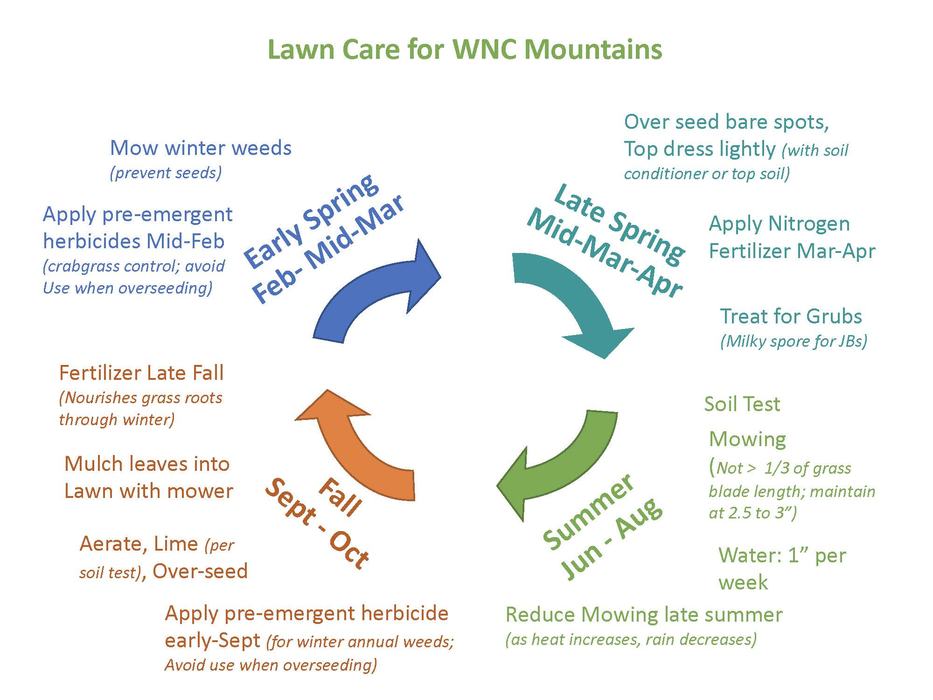
In western North Carolina cool season grasses are utilized for lawns. Grass species such as tall fescue and Kentucky bluegrass grow in the spring and fall when the weather is cooler. Cool season grasses are also green year-round and do not go into dormancy turning brown like warm season grasses do in the winter.
Caring for Your Lawn
(Updated: Oct. 1, 2026, 3:51 p.m.)
Planting Fescue Cool season grasses are planted from seed in late summer early fall Late August through September. Prepping soils to assure good seed/soil contact is critical. Overseeding existing fescue lawns should be done annually as well. Plant fescue from sod in the fall as well.
Irrigation Fescue is a cool season grass. It likes cooler weather and ample soil moisture. Fescue can struggle in hot dry summers, even dying back if the conditions are severe enough. Fescue lawns need at least one inch of water per week during the growing season (spring, summer and fall).
Fertilizing Cool season grasses such as fescue and Kentucky bluegrass should only be fertilized in February, September, and November. A good way to remember this is to fertilize on heart day, labor day, and turkey day. Applying fertilizer during warmer months can lead to disease and excess stress problems.
Soil Testing It is a good idea to complete a soil test to determine what nutrients your lawn needs. Excess nutrients can damage the waters of NC when they wash into streams with rain run-off. Get a free soil test from N.C. Cooperative Extension – Henderson County Center located at 100 Jackson Park Rd, Hendersonville (in Jackson Park). Results will tell you how much phosphorus, potassium, and lime you need. Soil tests should be completed at least every 3 years.
Fertilizer Facts – Fertilizer labels always display the three numbers in the same order (i.e. 10-10-10). These numbers represent the percent by weight of three important nutrients.
Nitrogen (N) – for leafy green growth
Phosphorus (P) – for root and bud growth
Potassium (K) – promotes disease tolerance and drought resistance.
For a bag of 10-10-10 there is 10% of each nutrient. A typical lawn fertilizer application is 1 pound of nitrogen per 1,000 square feet. Here are some common lawn fertilizer formulations and the amount of each needed for 1 pound of nitrogen.
Bag Labeled Amount Fertilizer for 1lb. N/1000 ft sq
6-2-0 17 lbs.
10-10-10 10 lbs.
14-3-6 7 lbs.
35-3-5 3 lbs.
For other formulations, divide 1 (1 lb N per 1,000 sq. feet) by the first number on the bag (% N).
Example Lawn Fertilizer Application
24-6-6 1 ÷ .24 = 4.17
This is a little more than 4 pounds of product.
Lawn area is 5,000 square feet.
4 X 5 = 20 lb. bag to cover lawn.
Lawn Diseases Most of the time when home gardeners think they have a lawn disease what they really have is a some other problem. We see this in the Henderson County Plant Disease and Insect Clinic. It is also observed on a state level.
According to an article by NC State University Turf specialists "most tall fescue samples submitted to our lab (48% of all submissions since 2008) are not diseased. Most issues stem from poor growing conditions, including shade, compaction, drought, heat, and traffic. Of the three major diseases of tall fescue, we observe brown patch in 28% of samples, gray leaf spot in 10%, and Pythium blight in 6%. Although Pythium blight receives a lot of discussion, it is a relatively rare disease of tall fescue. For it to develop, significant standing water in the lawn is required. We suspect most people confuse gray leaf spot with Pythium blight in tall fescue swards. The remaining 7% of samples we have received since 2008 were diagnosed as red thread, fairy ring, Ascochyta blight, and white patch combined."
Happy Grass is Healthy Grass Since most lawn problems are not caused by disease, gardeners should focus on improving poor growing conditions.
- Grass needs sun so reducing shade by pruning trees can improve grass health. To improve lawns in shade avoid foot traffic, mow grass taller, irrigate more often and limit weed killers.
- Soil compaction is one of the number one plant health issues in the built environment. Alleviating soil compaction via aeration allows water and oxygen to move more freely in soils.
- Proper irrigation during periods of drought and high heat can keep grass healthy.
- Foot traffic from people and pets can compact soil and damage grass plants. Avoid foot traffic and aerate to alleviate soil compaction.
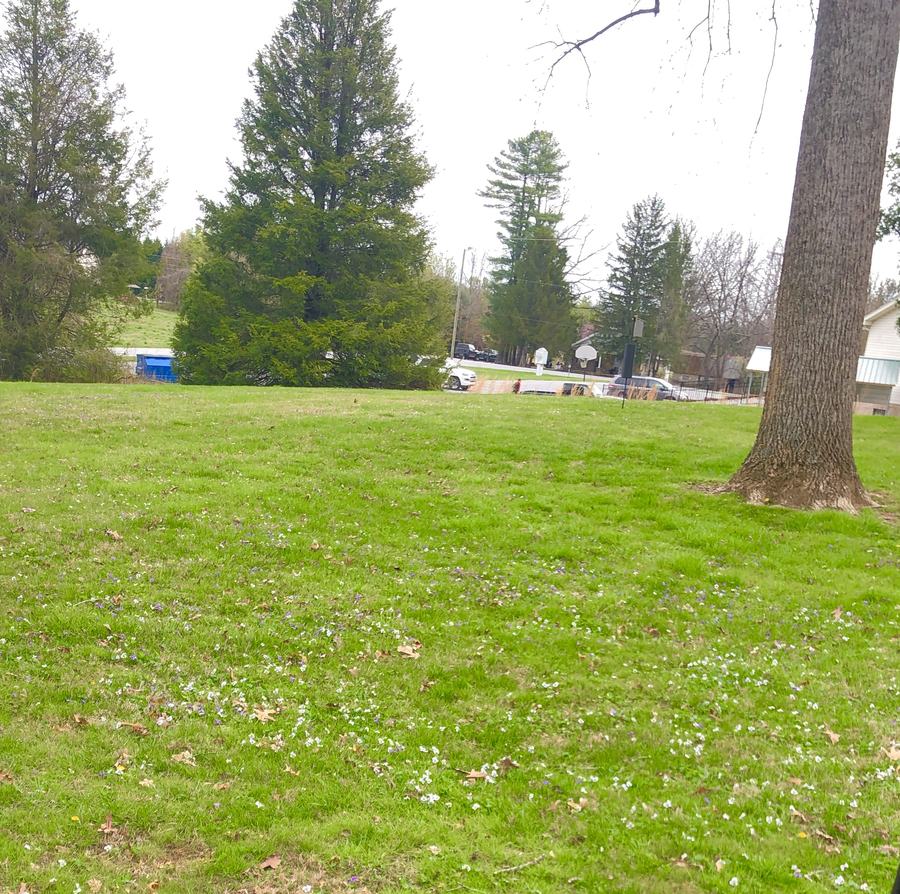
Controlling unwanted weeds in lawns starts with keeping lawns healthy. A dense full stand of fescue that is mowed at 3 inches tall will help choke out weeds. Sometimes even healthy lawns will be invaded by weeds and an herbicide becomes useful.
Pre-emergent Herbicides Preemergent herbicides prevent weeds from germinating. They must be applied BEFORE weeds begin to germinate. In Henderson County spring preemergent herbicides are applied in late February (when the Forsythia bloom) and fall preemergent herbicides are applied in late August through early September. Avoid applying preemergent herbicides just before a big rain that might wash the chemical into local streams. Do not overseed fescue for at least 2-4 months after preemergent herbicide applications.
Post-emergent Herbicides Post-emergent herbicides are applied after weeds germinate and are growing. Make sure to read the label carefully to assure the herbicide is safe for cool season grasses such as fescue. Avoid applications of herbicides during hot weather.
***Always read all pesticide labels thoroughly and follow the instructions on proper use and proper personal protective gear.
Join our mailing list!
Enter your email address to receive updates.
Written By